
Research Goal
This research explores how people buy, wear, care for, and pass on their shoes looking closely at sizing frustrations, messy closets, repair habits, and donation doubts.
My Process
research planning
Articulate questions and their options
Research Timeline
Research Proposal
Survey Circulation
Primary research
User Survey
analysis
Themes mapping

Research Insights
Understanding users: The quantitative user survey focused on urban Indian consumers who actively purchase footwear online or through D2C channels.
Empirical Findings
68% experience sizing anxiety across brands
74% discard shoes with minor, repairable damage
70% of owned wardrobe sits idle in closets
81% cite hygiene concerns in pre-owned/ rental footwear
62% distrust long-terms sustainability/ donation claims
behavioural root cause
Consumers avoid online secondary markets due to fit unpredictability across manufacturer standards
Inconvienent logistics and lack of trusted clobbers lead to premature footwear disposal
Users lack visibility into their wardrobe utility and financial Cost Per Wear metics
Absence of standardized quality inspection creates high trust friction for secondary usage
Low post donation transparency reduces consumer participation in circular programs
Competitive Analysis
Aim
To evaluate how existing footwear, e-commerce, and repair platforms handle sizing, care, resale, and donation, in order to identify critical service gaps and design opportunities for GetMyPair’s circular ecosystem.


The Future of Footwear
Owning the complete lifecycle of every pair of footwear
Users
Cobbler
Repair Shop Manager
Admin
About Casestudy
This case study highlights my work for GetMyPair Pvt. Ltd., spanning primary field research, multi-stakeholder UX systems, and business strategy.
Problem Statement
India’s urban consumer market generates millions of tons of footwear waste due to linear consumption models, lack of repair accessibility, and unstructured resale channels. Simultaneously, traditional artisans (cobblers) face economic marginalization due to a lack of digital integration and formal marketplace visibility.
Solution Overview
GetMyPair is a closed-loop socio-technical ecosystem that bridges informal street artisans and urban consumers through localized circular technology. By combining accessible multimodal interaction design with AI-driven wardrobe management, the platform transforms low-literacy informal footwear repair into a scalable, digitally integrated circular economy.
Research
Understanding users- The quantitative user survey focused on urban Indian consumers who actively purchase footwear online or through D2C channels.
Who is the user
Target Age Group: 13 - 50 years (Driving the majority of India’s fashion e-commerce consumption)
Geographic Focus: Tier 1 & Tier 2 Metros in India
Key Professions: Working professionals, Corporate Employees, Homemakers, Teens, Graduates, Fitness Enthusiaists
Research Method used
User Survey
Consumer Behavior Evolution
2010
Discovery & Status
Physical retail dominance. Limited online selection. Status tied to the brand logo.
"I buy what I see in-store to show who I am."
2020
Convenience & Speed
E-commerce explosion, "One-click" ordering, algorithm-driven trends, fast-fashion saturation.
"I buy what is recommended to me to save time."
2030
Sustainability & Stewardship
GetMyPair integration. Circularity, predictive care, and lifelong asset management.
"I own what fits my life, and I steward it for longevity."
Persona

Ananya
The Lifecycle Manager
Needs
Seeks a professional, seamless, and transparent end-to-end repair service to maximize the life of her premium footwear.
Frustrations
Exhausted by the time, effort, and lack of professional options required to maintain high-quality items.

Rita
The Family Resource Architect
Needs
Requires an automated digital system to track family-wide footwear inventory, growth cycles, and collective maintenance.
Frustrations
Mentally overwhelmed by manually tracking the constant cycle of outgrown, damaged, or misplaced footwear within her household.

Rahul
The Style Curator
Needs
Wants a frictionless way to rotate his collection via rental and AI-powered styling to stay trendy without the burden of hoarding.
Frustrations
Struggles with the lack of simple, trustworthy solutions for donating or rehoming lightly used, high-quality items.
The Value Shift
In 2010/ 2020 footwear is a depreciating asset. Once it wears out, you discard and buy again.n 2010/ 2020 footwear is a depreciating asset. Once it wears out, you discard and buy again.
In 2030 footwear is a maintained asset. Through AI-driven insights, GetMyPair informs the user when to clean, where to repair, and how to rehome. We transform a "cost" into an "investment."
Emerging Themes

digital rack
footwear care
P2p rent footwear
carbon credits
sell footwear
find cobblers around
ai assisted fit finder
footwear finder
footwear care
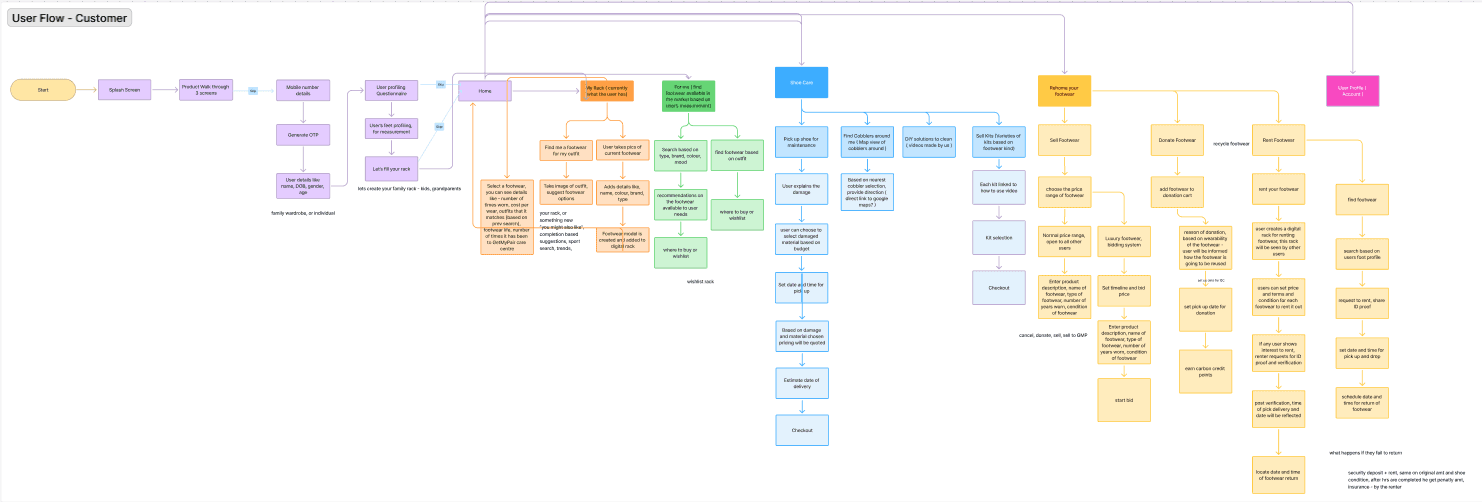
User Flow
UI Glimpse


Disclaimer
The platform is scheduled for commercial rollout in urban India in the coming weeks.